The Artifact
Two objects sit on the shelf: the Criterion Blu-ray of Monterey Pop, with its careful transfer and soft-grained Pennebaker colors, and the original Reprise soundtrack LP—thin cardboard, saturated photography, the dense mid-sixties mixing that gives even the quiet tracks a humid electricity.
Both artifacts capture the same event, but at different registers. The LP carries the audio: the speed, the swing, the violence, the sudden pockets of clarity. The film carries the body: Hendrix’s expression, his posture, the strange mix of reverence and mockery that lives in his gestures.
Revisiting them today, it’s easy to forget that in June 1967, most of the American audience seeing Jimi Hendrix on the Monterey stage had no idea who he was.
This dispatch begins with that disconnect—how an artist America had overlooked returned home fully formed, already transformed, and introduced himself by setting his own instrument on fire.
The Exile
Hendrix did not leave the United States in triumph. He left in frustration. Despite years on the chitlin’ circuit and R&B road bands—Little Richard, the Isley Brothers, King Curtis—he could not break past his station. Agents told him to stand still. Bandleaders told him to turn down. Club managers told him not to upstage the singer.
He was a Black American guitarist in a country that did not know what to do with a Black man playing psychedelic blues with virtuoso intensity. The industry couldn’t categorize him, so it didn’t invest.
So in late 1966, he took the offer from Chas Chandler and left for London. Within weeks, he became a phenomenon. Clapton, Townshend, Beck—all were stunned. Audiences saw him for what he was: a musician who understood the heritage of American blues and the future of amplified sound.
In six months, he became the most talked-about guitarist in Britain.
And then came Monterey.
Paul McCartney—already the most famous musician in the world—insisted the festival book Hendrix. He argued that the American audience deserved to see what they had been missing.
McCartney effectively said: You have to let him come home.
The Return
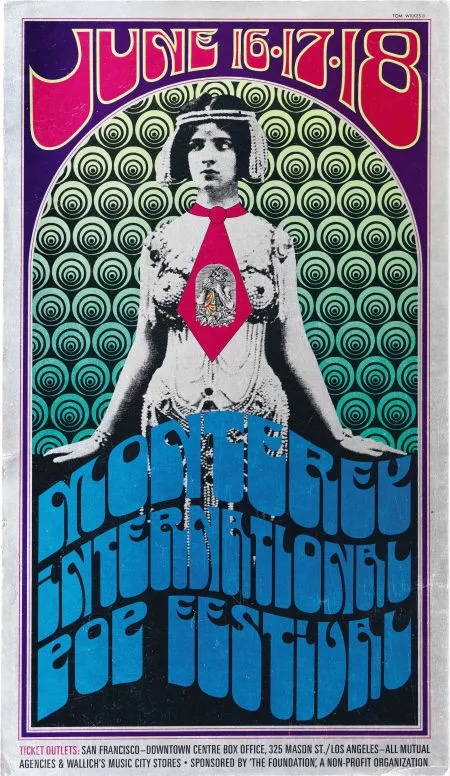
The Monterey International Pop Festival was designed as a watershed—an attempt to present the new counterculture as organized, artistically serious, and socially relevant. The environment was idealistic, chaotic, and visually overwhelming. The Vietnam War was escalating. Anti-war sentiment was rising. The Summer of Love was being mythologized even as it was happening. American youth culture was splitting from its parents’ generation with a speed that felt ungoverned.
And into this environment walked Jimi Hendrix—an American who had to become a star in England to be taken seriously in his home country.
His military past made the return even more charged.
Hendrix had served in the 101st Airborne Division, parachuting out of planes by day and learning guitar runs in the barracks by night.
He wasn’t a political activist in 1967, but he understood the war as only a veteran can: up close, without illusion.
The psychedelic revolution and the state’s military presence were not abstract forces to him—they were parallel realities he’d lived in.
All of that followed him onstage.
The Confrontation
Backstage, The Who and Hendrix negotiated the order of performance. Both were known for explosive finales; both understood the stakes. Townshend smashed guitars. Hendrix played them to the edge of collapse. Neither wanted to follow the other.
“Who’s going to go on first?”
Legend has it the tension was real.
Townshend insisted The Who go on before him.
Hendrix agreed—and said he would “pull out all the stops.”
The Who detonated their set:
amps toppled, smoke billowed, Keith Moon waged war on his kit.
The crowd barely recovered before Hendrix walked onstage.
The Performance
What followed was less a debut than an eruption.
From the first bars of “Killing Floor,” he was faster, looser, more precise than anyone expected. He played behind his head, between his legs, with his teeth—not as gimmick, but as an extension of his physical understanding of the guitar.
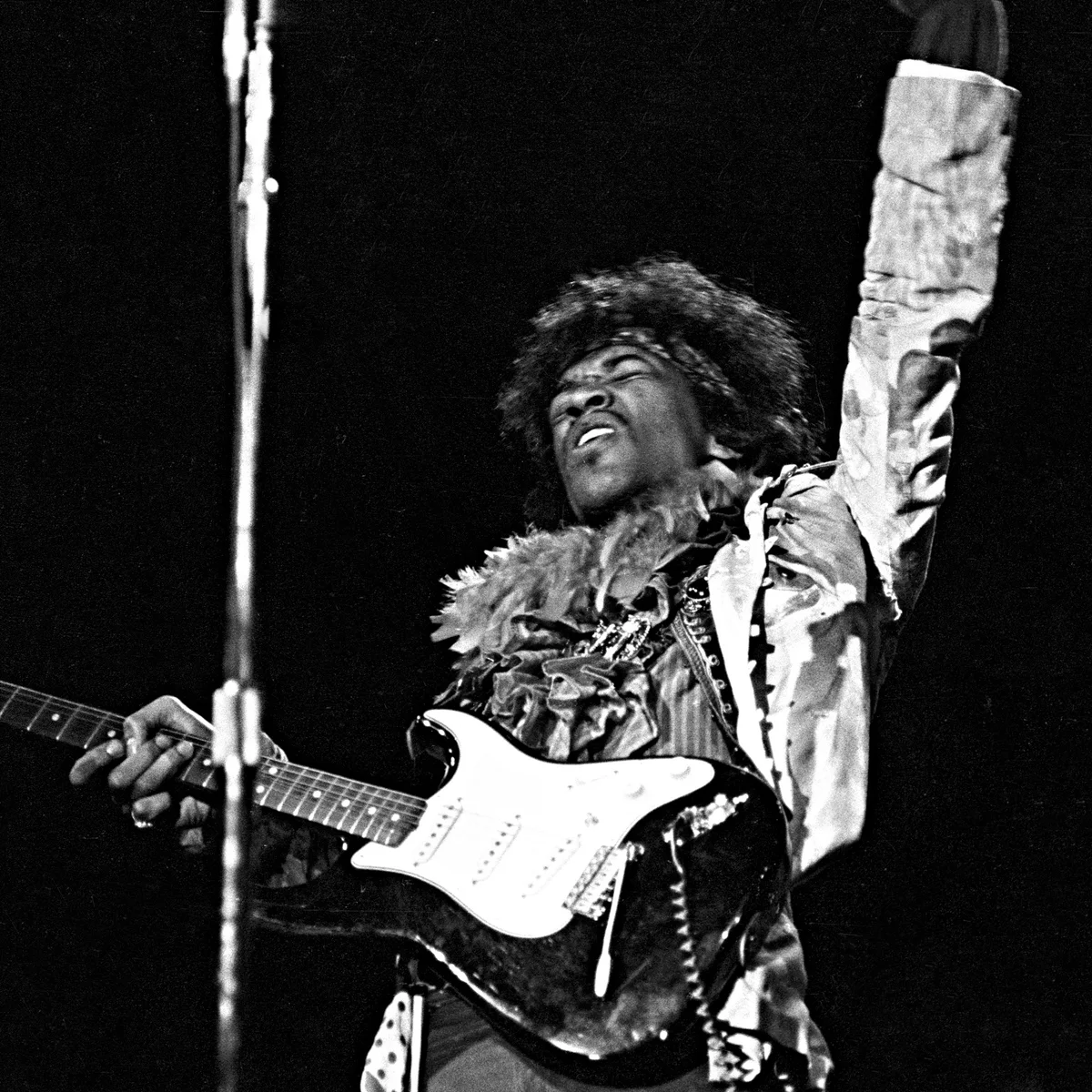
He was not simply a technician.
He was a performer with a fully articulated aesthetic—sexual, humorous, violent, tender, fluid.
A Black American artist reclaiming the blues in a space where the blues had been repackaged for white audiences.
By the time he reached “Wild Thing,” the mood shifted.
He tightened the feedback, coaxing the amp into a controlled scream.
He knelt before his guitar as though attending a ritual.
He anointed it with lighter fluid.
He set it on fire.
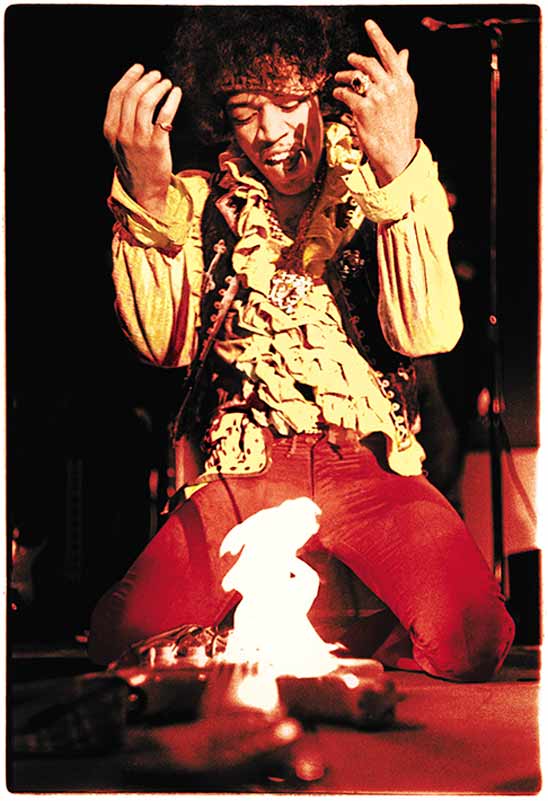
In the film, the flames rise blue and orange, flickering against his face.
In the LP, you hear only the aftermath—the smash, the collapse, the feedback bursting like pressure escaping a pipe.
To call it destruction is to miss the point.
It was an offering.
It was spectacle.
It was reclamation.
It was a declaration of arrival so unmistakable it has never entirely settled into a single interpretation.
The Film That Preserved It
Without D.A. Pennebaker’s footage, the Hendrix myth would be different—older, blurrier, less immediate. Pennebaker’s camera wasn’t intrusive; it watched. It trusted the performance to explain itself.
The grain, the soft focus, the saturated reds and oranges—they turned the set into an artifact of record.
The film preserved what the LP could not: the grin, the control, the precision behind the apparent chaos.
It preserved the cultural shock of the American audience witnessing Hendrix for the first time.
The Criterion Blu-ray you own is part of that lineage:
an archive of an archive, cleaned, clarified, but still carrying the heat and urgency of the original footage.
The Cultural Weather of 1967
To understand the moment, you have to understand the year.
America was on the brink of something.
The war was escalating.
Civil rights victories existed alongside new forms of backlash.
Psychedelia wasn’t a style; it was an attempt to reframe consciousness in a decade that felt increasingly impossible to process.
Hendrix’s performance did not comment directly on these shifts.
It didn’t need to.
It embodied them: the tension between spectacle and sincerity, violence and art, chaos and expertise.
A Black American guitarist lighting his instrument on fire at a predominantly white festival in a moment of national fracture had meanings that no one onstage needed to explain.
Monterey was not a protest.
But it was a statement.
And Hendrix made it unavoidable.
The Afterlife
Within days, Hendrix was a star in America.
Within months, he was a cultural force.
Within a few years, he was gone.
But the Monterey performance survives—on the Reprise LP, on the Criterion transfer, online in fragments and restorations. It survives because the camera captured not just the show but the transformation: the moment exile became return, the moment the country finally recognized the artist it had overlooked.
It remains one of the most charged documents of American cultural history—not because of the fire alone, but because the entire performance is a record of recognition delayed and then delivered all at once.
Closing
Hendrix did not come home quietly.
He came home through flames, through volume, through control so precise it looked like chaos.
He came home as the musician America didn’t know it had produced—an artist shaped by its music, ignored by its industry, welcomed by its youth, and filmed at the exact moment he reintroduced himself.
The Ministry keeps an eye on moments like this: when an artifact captures not just a performance, but a cultural shift arriving in real time.
Welcome to the Ministry.